
Research · 20 October 2026
What Is Desert Cotton? A Guide to the UAE's Native Aerva javanica
A plant nobody planted, and how it became the first entry in mn's study of UAE flora.
By Myriem Boussaad
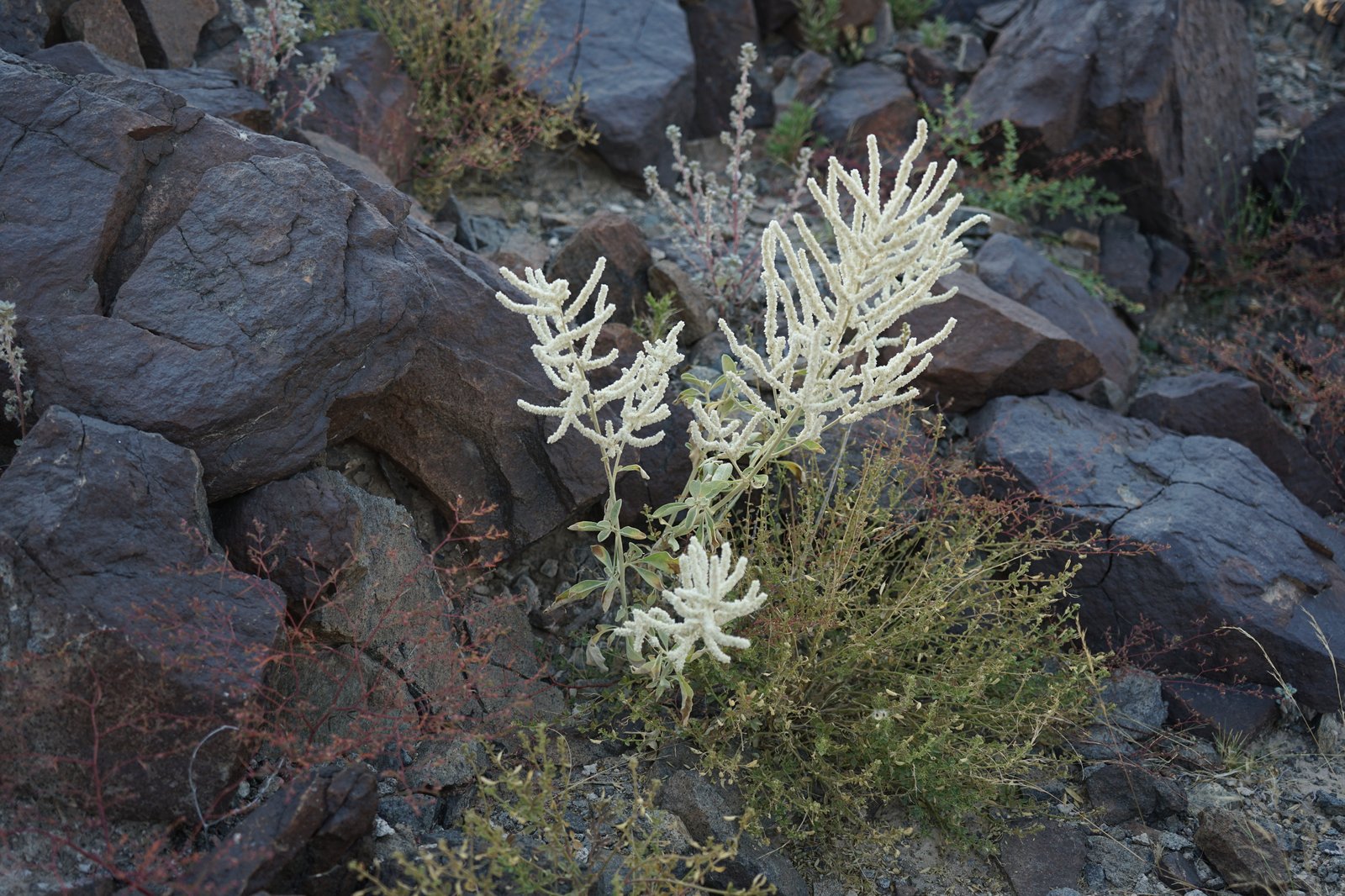
Desert cotton (Aerva javanica), الآرا or al-ara in Arabic, is the soft, pale shrub that grows wild along UAE roadsides, sandy lots and wadis. Nobody has ever farmed it here. It was gathered instead: its woolly flower heads packed into cushions and camel saddles, the whole plant used by healers for wounds, pain and the gut.
In short
• What it is: a perennial shrub, also called kapok bush or snow bush. No relation to cotton, despite the name.
• Where it grows: across the Emirates, most of all in the north. Roadsides, wadis, empty sandy lots.
• Why it's soft: its 2 mm flowers are covered in tiny star-shaped hairs.
• How it was used: gathered, never planted. Stuffing for cushions and saddles; medicine for wounds, toothache and the gut.
• Who's using it now: designers and scientists, still finding new uses for it.
What is desert cotton?
Desert cotton is Aerva javanica, a perennial shrub in the amaranth family. It also goes by kapok bush and snow bush (El-Ghonemy, 1993).
Most of us know it as الآرا, al-ara. Depending on the area, you might also hear tirf, tuwaim or shajarat al-ghazaal (Shahin, Jaleel & Alyafei, 2021). The UAE's online encyclopedia of medicinal plants records nine Arabic names in all.
The name “kapok bush” came from how it was used. Across the region, its fluffy flower heads did the same job as kapok tree fibre: stuffing (Mandaville, 2011, p.154). The name stuck, though the plant is related to neither kapok tree nor cotton.
Where does desert cotton grow in the UAE?
Almost everywhere, once you start noticing it. Desert cotton grows across the Emirates, most commonly in the north, and is one of 622 native plants in the UAE Flora database.
It makes its home on roadsides, disturbed ground, the silt of rocky wadis and open alluvial plains (El-Ghonemy, 1993). It has been recorded on sandy ground in Abu Dhabi, Dubai and Sharjah, and up in Wadi Wurayah National Park in Fujairah (Jongbloed et al., 2003; Karim & Fawzi, 2007).
It sends down a taproot as long as the plant is tall, and researchers have pointed to it as a plant for steadying dunes and replanting worn-out rangeland in Saudi Arabia (Mouhoub et al., 2018). It is salt-tolerant too, according to designer Tasnim Tinawi's research into the plant (Tashkeel, 2021).
No one has ever needed to plant it. It turns up on its own, in the overlooked ground between things.
Why does the flower look like cotton?
Look closely at a flower head and you'll see why. Each flower is about 2 mm across and covered in tiny star-shaped hairs, called trichomes. A 2021 study at UAE University photographed them under a scanning electron microscope, using plants growing wild near Al Ain.
Packed together along the stem, those hairs give the plant its soft, almost woven look, despite there being no weaving involved.
The flowers are fragrant too. The same study found 29 compounds in their essential oil, which yields the most in spring (Shahin, Jaleel & Alyafei, 2021).
How was desert cotton used in the home?
Families living in the UAE desert once gathered its flower heads to stuff cushions and camel saddles, as The National reported in 2010. Nothing was done to the fluff first. It was picked at the right time and packed in as it was. The same practice turns up across Arabia in James Mandaville's record of desert plant use (Mandaville, 2011, p.154), and as far away as Egypt's Eastern Desert (El-Tayeh et al., 2020).
In every record we found, the plant was gathered, never cultivated. It wasn't a crop with a season. It was simply there when you needed it.
How was desert cotton used as medicine?
Here, healers used the whole plant for kidney stones, inflammation, skin infections, toothache, headaches and intestinal worms. The flowers were mixed with water into a paste and pressed onto wounds to stop the bleeding (El-Ghonemy, 1993). The plant was also burned as a fumigant, and was said to work as an aphrodisiac (El-Ghonemy, 1993; Al-Yahya et al., 1990).
Most of what we know comes from El-Ghonemy's 1993 Encyclopedia of Medicinal Plants of the United Arab Emirates, still the go-to reference, and cited in the UAE's online plant encyclopedia.
Across the region the list runs a little longer. In Saudi Arabia (Arbab et al., 2016) and Pakistan (Qureshi & Bhatti, 2009), people gargled it for sore gums and toothache, used the seeds for headaches, and made it into remedies for diarrhoea and aching joints. Different places, but the same short list of complaints: pain, wounds and the gut.
Is anyone using desert cotton today?
Yes, and not just us. In 2021, designer Tasnim Tinawi turned its cotton buds into Desert-Cotton, a plant-based alternative to synthetic stuffing, through Tashkeel's Tanween programme. The buds were screened, dried and treated before use (Tashkeel, 2021).
Her Kapok series, a chair and footrest stuffed with it, showed at Downtown Design during Dubai Design Week 2021. The chair was made in an edition of 10 (Tashkeel, 2021). Her work asks what the plant could replace, and at what scale.
Scientists are paying attention too. The 2021 UAE University study found the flowers' oil to be a good natural source of antioxidants.
For us, desert cotton is where mn's study of UAE flora begins. Made by the sun follows what we made from it.
Questions we get asked
Is desert cotton related to cotton?
No. The cotton in your clothes comes from the mallow family; desert cotton (Aerva javanica) is an amaranth. It earned the name from its soft flower heads, which did the same job cotton or kapok would: filling cushions and saddles.
Is desert cotton endangered in the UAE?
No. It is common and widespread, and the UAE National Red List assesses it as Least Concern (UAE National Red List). It grows on roadsides, wadis and sandy ground across the Emirates, and has never needed cultivating.
What is desert cotton called in Arabic?
Most commonly الآرا, al-ara. You'll also hear tirf, tuwaim and shajarat al-ghazaal, depending on the area (El-Ghonemy, 1993; Shahin, Jaleel & Alyafei, 2021). The UAE's online encyclopedia of medicinal plants lists nine names in all.
Can desert cotton be used as medicine today?
It has a long history in folk medicine here and across the region, and labs are now studying its properties (Arbab et al., 2016; Shahin, Jaleel & Alyafei, 2021). That research is still early, so check with a doctor before trying any herbal remedy.
Read next
Desert cotton is the first plant in mn's study of UAE flora. To see what we made from it, read Made by the sun, on the Desert Cotton scarf and pocket square.
References
Al-Yahya, M.A., Al-Meshal, I.A., Mossa, J.S., Al-Badr, A.A. and Tariq, M. (1990). Saudi Plants: A Phytochemical and Biological Approach. Riyadh: King Abdulaziz City for Science and Technology.
Arbab, A.H., Parvez, M.K., Al-Dosari, M.S., Al-Rehaily, A.J., Ibrahim, K.E., Alam, P., Alsaid, M.S. and Rafatullah, S. (2016). Therapeutic efficacy of ethanolic extract of Aerva javanica aerial parts in the amelioration of CCl4-induced hepatotoxicity and oxidative damage in rats. Food & Nutrition Research, 60, 30864. doi.org/10.3402/fnr.v60.30864
El-Ghonemy, A.A. (1993). Encyclopedia of Medicinal Plants of the United Arab Emirates, 1st edn. Al-Ain: United Arab Emirates University.
El-Tayeh, N.A., Galal, H.K., Soliman, M.I. and Zaki, H. (2020). Association of morphological, ecological, and genetic diversity of Aerva javanica populations growing in the Eastern Desert of Egypt. Agronomy, 10(3), 402. doi.org/10.3390/agronomy10030402
Encyclopedia of Medicinal Plants of the UAE (n.d.). Aerva javanica / الآرا, citing El-Ghonemy (1993) and Al-Yahya et al. (1990). medicinalplants.doh.gov.ae
Jongbloed, M.V.D., with Feulner, G.R., Böer, B. and Western, A.R. (2003). The Comprehensive Guide to the Wild Flowers of the United Arab Emirates. Abu Dhabi: Environmental Research and Wildlife Development Agency.
Karim, F.M. and Fawzi, N.M. (2007). Flora of the United Arab Emirates, Vols. 1 and 2. Al-Ain: United Arab Emirates University.
Mandaville, J.P. (2011). Bedouin Ethnobotany: Plant Concepts and Uses in a Desert Pastoral World. Tucson: University of Arizona Press, p.154.
Mouhoub, F., Chabane, D., Ouafi, S. and Bouguedoura, N. (2018). Impact of arid climate on sex distribution, morphological and anatomical organization of a medicinal herb Aerva javanica in southern Algerian Sahara. Pakistan Journal of Botany, 50(1), 313–320. pakbs.org
Qureshi, R. and Bhatti, G.R. (2009). Folklore uses of Amaranthaceae family from Nara Desert, Pakistan. Pakistan Journal of Botany, 41(4), 1565–1572. pakbs.org
Shahin, S.M., Jaleel, A. and Alyafei, M.A.M. (2021). Yield and in vitro antioxidant potential of essential oil from Aerva javanica flower with special emphasis on seasonal changes. Plants, 10(12), 2618. doi.org/10.3390/plants10122618
Tashkeel (2021). Meet the designer: Tasnim Tinawi (Tanween 2021). tashkeel.org
The National (2010). Battle to save Dubai desert's wonders, 13 February. thenationalnews.com
UAE Flora database (n.d.). Aerva javanica (kapok bush, desert cotton). uaeflora.ae
UAE National Red List (n.d.). Aerva javanica. nationalredlist.org
Western, A.R. (1989). The Flora of the United Arab Emirates: An Introduction. Al-Ain: United Arab Emirates University.
